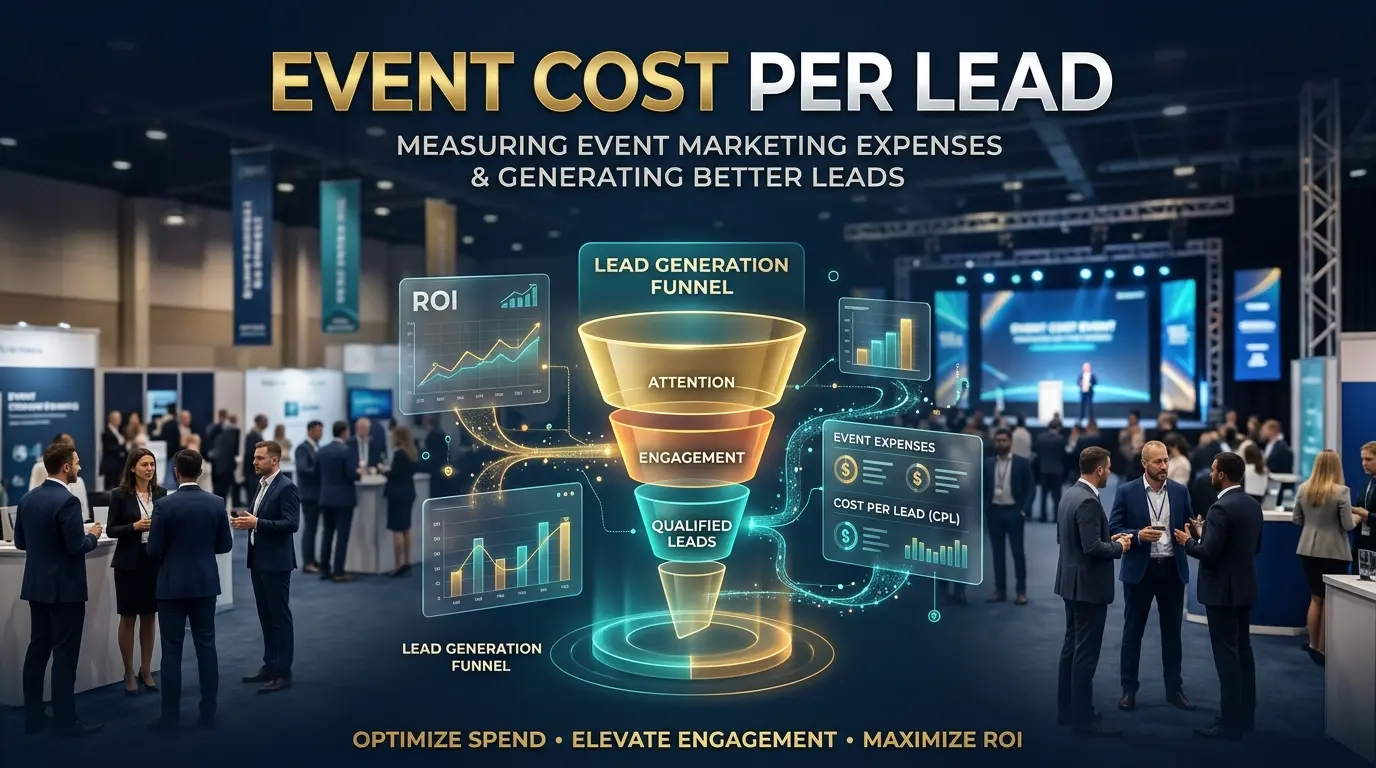
Event cost per lead helps businesses understand how much they spend to generate potential customers through conferences, exhibitions, trade shows, seminars, and other events. By evaluating event expenses alongside lead quality, conversion rates, and revenue opportunities, organizations can determine whether their event marketing activities are delivering meaningful results. This article explores the financial factors behind event lead generation, the importance of accurate tracking, and how businesses can improve event campaign performance while making better use of their marketing budgets.
Understanding the Cost Behind Every Event Lead
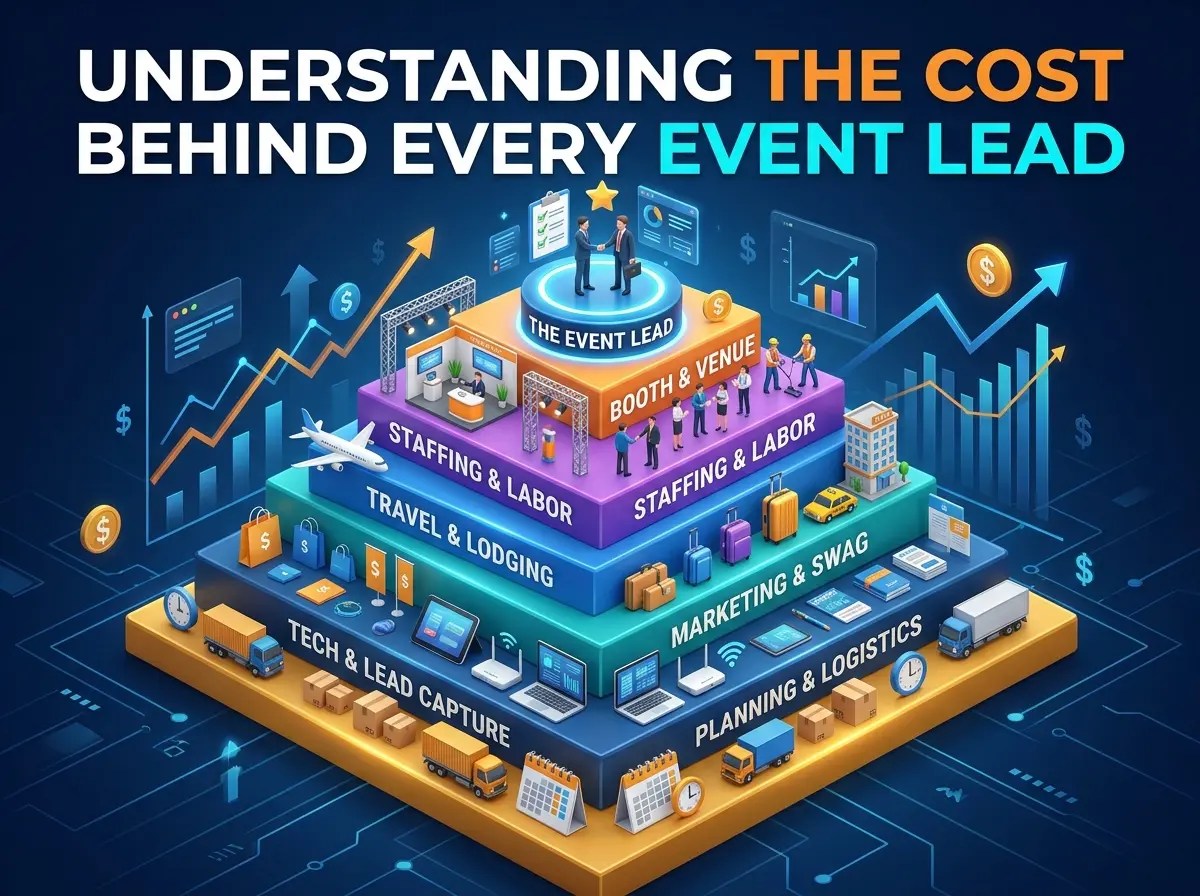
Events create valuable opportunities for businesses to meet potential customers, introduce their products, build professional relationships, and generate new business opportunities. Whether an organization participates in an industry exhibition, hosts a conference, or organizes a product demonstration, every event involves financial investment. However, the number of attendees or contacts collected does not always reveal whether that investment was worthwhile.
A business may spend thousands on an exhibition booth, promotional materials, travel, staffing, and digital advertising but generate only a limited number of qualified prospects. Another organization might participate in a smaller event and attract fewer visitors while producing stronger sales opportunities. These differences make financial evaluation an essential part of event marketing.
Event Cost Per Lead provides a way to understand the relationship between event spending and the number of leads generated. It helps businesses evaluate how much they invest to acquire each potential customer through an event-related activity.
However, the calculation alone does not explain the complete value of an event. A low cost per lead may look attractive, but those leads might have little interest in purchasing. Similarly, an expensive event may generate fewer leads but introduce the business to decision-makers with significant purchasing potential.
For this reason, organizations should examine event expenses alongside lead quality, conversion opportunities, and eventual revenue. This broader perspective makes it easier to identify worthwhile events and develop more effective marketing investments.
The Financial Meaning of Event Cost Per Lead
Event cost per lead is calculated by dividing the total relevant event marketing expenses by the number of leads generated through that event.
For example, imagine a company spends $12,000 participating in a business exhibition and collects 300 leads. Its average cost per lead would be $40.
This figure provides a starting point for evaluating the financial efficiency of the event. However, businesses should be careful about which expenses they include in the calculation.
The total investment may involve booth rental, registration fees, transportation, accommodation, employee wages, promotional materials, event technology, sponsorship costs, and advertising. Some organizations may also include post-event follow-up expenses because these activities are directly connected to converting event contacts into opportunities.
Consistency is important when comparing events. If one event calculation includes staffing and travel while another only includes registration fees, the resulting figures will not provide a fair comparison.
Businesses should also distinguish between total contacts and qualified leads. A visitor who simply enters an email address for a giveaway may not represent the same commercial opportunity as a decision-maker who requests a product demonstration.
Consequently, calculating cost per qualified lead alongside overall cost per lead can provide a more useful understanding of event performance.
What Makes Event Lead Generation Expensive?
The financial requirements of event marketing can vary significantly depending on the event format, location, audience, and business objectives. A local networking session may require relatively little investment, while an international trade exhibition can involve substantial expenses.
Understanding these costs helps businesses identify where their event budgets are being used and which activities contribute most to lead acquisition.
Venue and participation fees are often among the largest expenses. Exhibitors may need to pay for booth space, sponsorship packages, registration, electricity, internet access, and additional facilities. Larger or more popular events may also charge higher participation rates because of their audience reach and industry reputation.
Travel and accommodation create another major expense, particularly when employees attend events outside their usual business locations. Transportation, hotel bookings, meals, and other travel requirements can increase the overall investment.
Booth design and promotional materials also influence the total Event Lead Generation Cost. Businesses may invest in banners, product displays, brochures, demonstration equipment, branded merchandise, and interactive presentations to attract visitors.
Digital promotion adds another financial consideration. Paid advertisements, email campaigns, event landing pages, social media promotions, and registration campaigns may all contribute to the cost of attracting attendees and generating leads.
Staffing should not be overlooked either. Employees responsible for booth management, product demonstrations, sales conversations, and lead collection contribute valuable working hours. Even when existing employees handle these responsibilities, their time represents an operational investment.
The challenge is not necessarily to eliminate these expenses. Instead, businesses should understand which investments create meaningful opportunities and which costs could be reduced without affecting the event experience.
Why Cost Per Event Lead Does Not Tell the Whole Story
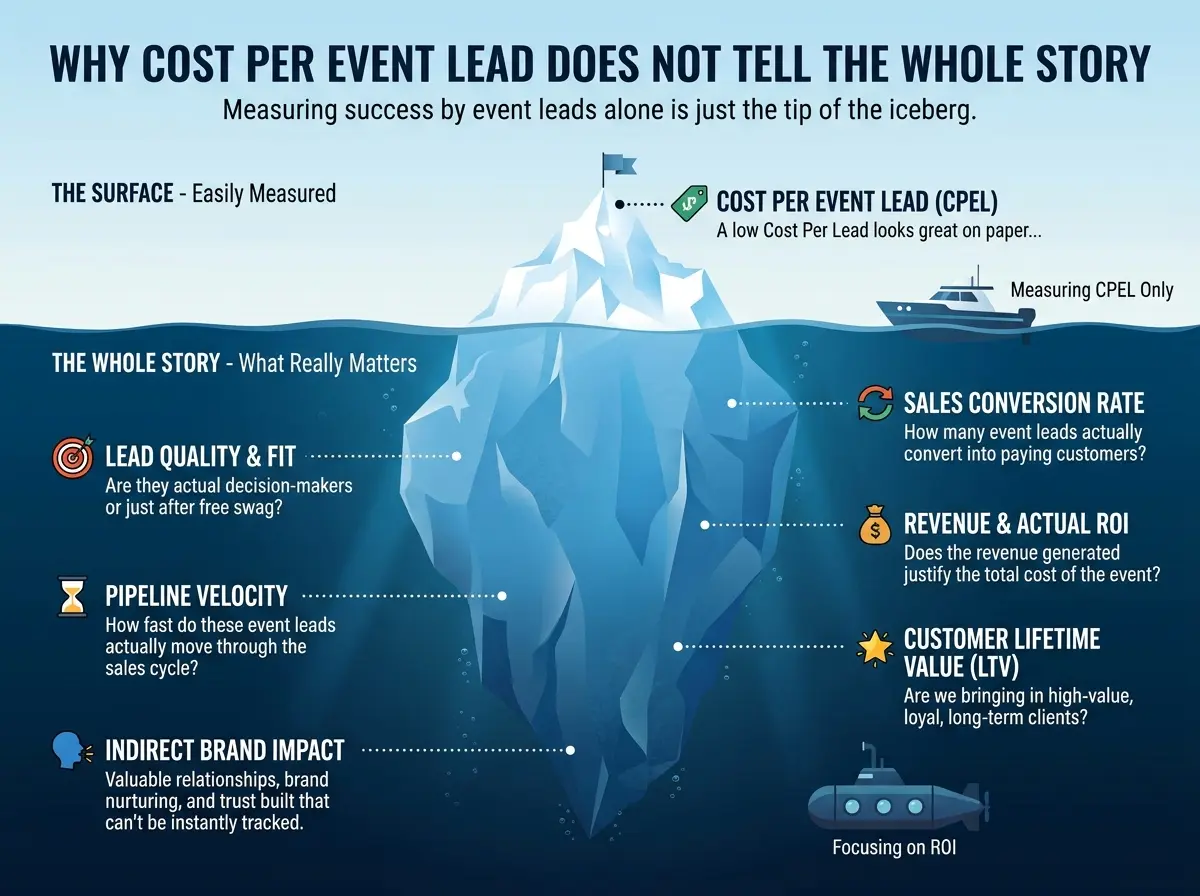
A low cost per event lead can make an event appear financially successful, but the actual value of those leads depends on what happens after they are collected.
Consider two companies participating in separate industry exhibitions. The first spends $5,000 and generates 250 leads, resulting in a cost per lead of $20. The second spends $10,000 and generates 200 leads, resulting in a cost per lead of $50.
At first glance, the first company appears to have achieved better results. However, suppose only 10 of its leads become qualified sales opportunities, while the second company generates 60 qualified opportunities.
The financial interpretation changes considerably.
| Performance measurement | Event A | Event B |
|---|---|---|
| Total event expenses | $5,000 | $10,000 |
| Total leads | 250 | 200 |
| Cost per lead | $20 | $50 |
| Qualified leads | 10 | 60 |
| Cost per qualified lead | $500 | $166.67 |
Illustrative figures for comparison.
This example demonstrates why businesses should evaluate lead quality rather than focusing exclusively on lead volume.
The second event generates more qualified opportunities for every dollar invested, even though its overall cost per lead is higher.
Lead relevance, purchasing authority, budget availability, business requirements, and readiness to buy all influence the commercial value of an event-generated contact.
For businesses selling high-value products or services, a smaller number of qualified prospects may be considerably more valuable than hundreds of general inquiries.
A better evaluation therefore considers both acquisition cost and the likelihood that generated leads will eventually become customers.
Event Marketing ROI: Connecting Leads With Revenue
Event Marketing ROI provides a broader financial perspective by examining the return generated from event-related investments.
While cost per lead measures the expense of generating contacts, ROI considers whether the resulting business outcomes justify the investment.
A basic ROI calculation is:
For example, if a company invests $15,000 in an event and generates $45,000 in attributable revenue, its basic return on investment is 200%.
However, businesses should distinguish between revenue and profit when evaluating financial performance. Revenue-based ROI can provide an initial view, but profit-based calculations offer a more complete understanding because they account for the cost of delivering products or services.
Event ROI can also involve benefits that are not immediately reflected in sales figures. These may include stronger brand recognition, new distribution relationships, strategic partnerships, customer education, and future sales opportunities.
Some of these benefits take months to produce measurable results. Therefore, evaluating an event immediately after it ends may provide an incomplete picture.
Businesses should connect event reporting with their sales pipeline and continue monitoring the opportunities generated through each campaign. This allows them to understand how event participation contributes to both immediate revenue and longer-term commercial growth.
Managing the Event Marketing Budget More Effectively
An effective Event Marketing Budget begins with a realistic understanding of the event’s objectives and expected financial requirements.
Businesses should consider the audience they want to reach, the number of qualified leads they hope to generate, the value of their products, and the resources required to participate.
Budget allocation should reflect the potential contribution of different activities rather than being determined entirely by previous spending habits.
For example, a company attending an industry conference may need to allocate significant resources to booth presentation and product demonstrations because direct conversations are central to its sales approach. Another business may benefit more from pre-event digital promotion and targeted appointment scheduling.
The same spending structure does not necessarily work for every event.
Unexpected expenses should also be considered. Last-minute equipment requirements, additional promotional materials, transportation changes, and technical problems can increase the final investment.
Businesses can maintain better financial control by recording expenses throughout the event rather than waiting until the campaign ends. This makes it easier to identify overspending and understand the actual cost of participation.
Budget decisions should also consider the relationship between marketing and sales teams. If the sales department receives insufficient resources to follow up with event-generated leads, the organization may lose opportunities despite investing heavily in attracting visitors.
The most effective budget supports the complete event journey, from initial promotion to post-event customer communication.
Lead Acquisition Cost and the Value of Qualified Prospects
Lead acquisition cost helps businesses understand the financial resources required to bring potential customers into their sales process. In event marketing, this measurement becomes particularly useful when organizations compare different event formats and lead-generation channels.
Not every event contact represents the same level of interest. Someone attending a general presentation may be exploring an industry topic, while a visitor requesting a detailed product quotation may already have a specific purchasing requirement.
These differences influence the resources needed to convert each lead.
A useful approach is to distinguish between newly collected contacts, marketing-qualified leads, and sales-qualified leads. This creates a clearer picture of how prospects move from initial interaction toward a potential business relationship.
For instance, a company might generate 500 contacts from an exhibition but identify only 120 as relevant marketing prospects. Of those, 40 may eventually meet the sales team’s qualification requirements.
Evaluating the cost at each stage helps management understand where leads are being lost and whether the event attracted the right audience.
It also encourages closer coordination between marketing and sales. Marketing teams can focus on generating relevant contacts, while sales representatives can provide feedback about lead quality and purchasing intent.
This connection is important because event success should not end when visitor information is collected. The real opportunity lies in turning suitable prospects into meaningful business conversations.
Event Lead Conversion Rate: Measuring What Happens After the Event
The Event Lead Conversion Rate measures how effectively event-generated leads move toward a desired outcome.
Depending on the business, the desired outcome may be a completed purchase, booked consultation, signed contract, product demonstration, or another defined action.
A simple lead-to-customer conversion calculation is:
Suppose a business collects 200 leads from an exhibition and eventually acquires 20 customers. Its lead-to-customer conversion rate is 10%.
This measurement becomes more valuable when compared across events, audience segments, and promotional approaches.
A lower conversion rate may indicate that the event attracted visitors who were not suitable prospects. However, it could also reflect weak follow-up communication, unclear product information, or a lengthy purchasing process.
Businesses should therefore avoid assuming that every conversion problem originates at the event itself.
The time required to convert leads also matters. Some customers make purchasing decisions within days, while larger business transactions may require several months of discussions, approvals, and negotiations.
Tracking conversions over an appropriate period provides a more realistic evaluation of event performance.
Event Lead Tracking and the Importance of Accurate Attribution
When businesses participate in multiple events throughout the year, identifying the source of every lead becomes increasingly important.
Without reliable Event Lead Tracking, companies may struggle to determine which exhibition, conference, sponsorship, or promotional activity generated a particular sales opportunity.
Lead tracking systems help connect individual contacts with their original acquisition sources. This information can include event names, registration details, campaign identifiers, meeting records, and subsequent sales activities.
Customer relationship management platforms are particularly useful because they allow marketing and sales teams to maintain a shared record of lead interactions.
For example, a visitor might scan a QR code at an exhibition booth, submit a contact form, and later receive a sales consultation. If the original event source is recorded correctly, the company can connect the resulting opportunity with its event investment.
Tracking should also capture lead status changes. This allows managers to understand how many event contacts remain unqualified, how many progress to sales discussions, and how many eventually become customers.
Consistent attribution is essential when multiple marketing channels influence the same purchase. A prospect might first discover a company through search, meet its representatives at an event, and later respond to an email campaign.
Businesses should establish clear reporting rules to avoid assigning the entire commercial outcome to the wrong channel.
Good tracking does more than improve reporting accuracy. It gives organizations the evidence needed to make better decisions about future event participation.
Understanding Event Campaign Performance Through Better Reporting
Event Campaign Performance should be evaluated through a combination of financial, marketing, and sales measurements. Looking at a single metric rarely explains why an event succeeded or failed.
For example, an event might attract a large audience but generate very few meaningful inquiries. Another might have limited attendance but create valuable relationships with industry decision-makers.
Performance reporting helps businesses understand these differences.
A useful event report connects attendance, engagement, lead generation, qualification, follow-up activity, and eventual sales outcomes. It should also identify the expenses associated with each activity so managers can compare investment with results.
Audience engagement can provide additional context. Booth visits, product demonstrations, presentation attendance, consultation requests, and meaningful conversations may reveal how effectively an organization attracted its intended audience.
However, these activities should not automatically be counted as qualified leads. Someone who watches a demonstration may have no immediate purchasing interest, while a visitor who requests a detailed proposal may represent a stronger opportunity.
Businesses can improve reporting by separating engagement measurements from lead-generation outcomes.
Another important consideration is comparison over time. Reviewing multiple events can reveal which formats, locations, audience segments, and promotional approaches consistently generate better results.
This information helps organizations move away from decisions based on assumptions and toward more reliable financial planning.
Reducing Lead Generation Expenses Without Sacrificing Quality
Reducing Lead Generation Expenses does not necessarily mean choosing cheaper venues, smaller booths, or fewer promotional activities. The more important objective is to eliminate spending that does not contribute meaningfully to audience engagement or lead acquisition.
One opportunity involves improving audience targeting before the event. Businesses that promote their participation to relevant customer groups may attract more suitable visitors than those relying entirely on general event visibility.
Appointment scheduling can also make event participation more productive. When sales representatives have confirmed meetings with potential customers, they can use their time more effectively instead of depending entirely on spontaneous booth visits.
Digital resources can reduce certain physical expenses as well. Electronic brochures, QR-code-based information, digital presentations, and online registration systems may reduce printing and administrative requirements.
Staff allocation is another important consideration. Businesses should ensure that enough employees are available to manage visitor conversations without assigning excessive resources to low-demand activities.
Organizations can also review their promotional spending after each event. If certain advertisements, sponsorship placements, or materials consistently produce limited results, those investments may need to be adjusted.
However, cost reduction should never undermine lead quality. Cutting expenses that attract relevant decision-makers may lower the immediate budget while weakening the commercial value of the event.
The better approach is to focus on spending efficiency and preserve the activities that contribute to meaningful customer opportunities.
Event Marketing Cost Analysis: Comparing Different Event Opportunities
A detailed Event Marketing Cost Analysis allows businesses to compare events before committing their budgets.
Different event formats create different financial and commercial opportunities. An international trade show may offer access to established industry buyers, while a smaller regional conference may provide more direct conversations with a specialized audience.
Comparing these opportunities requires looking beyond participation fees.
Businesses should examine expected attendance, audience relevance, sponsorship exposure, competitor participation, historical lead quality, and the resources required to generate meaningful engagement.
For instance, an expensive industry exhibition may be worthwhile if it provides access to important purchasing decision-makers. A less expensive event may be a better investment when its audience closely matches the company’s target market.
Historical performance can make these comparisons more reliable. Organizations that record event expenses, qualified leads, conversion rates, and revenue can develop benchmarks for evaluating future opportunities.
It is also useful to calculate cost per qualified lead and customer acquisition cost alongside the standard cost per lead.
These measurements reveal whether an event generates valuable prospects at a sustainable cost.
For organizations participating in several events, centralized reporting can help identify which activities deserve greater investment and which may need a different approach.
The Influence of Digital Visibility on Event Lead Generation

Event lead generation does not begin when visitors enter a venue. Potential attendees often discover events through search engines, social media, industry websites, email communication, and online communities.
Digital visibility can therefore influence both attendance and lead acquisition costs.
A well-structured event website should communicate essential information, including the event’s purpose, location, schedule, speakers, registration details, and intended audience. When visitors can easily find relevant information, they have a better opportunity to understand the event and decide whether to participate.
Mobile search visibility is particularly important because many people research events through smartphones. Slow-loading pages, difficult registration forms, and poorly organized information can discourage potential attendees.
Businesses can strengthen this experience through Event Mobile SEO, which focuses on improving mobile search visibility and making event information easier to access.
Trust also influences whether people decide to attend or interact with an event organizer. Previous attendee experiences, testimonials, industry recognition, and credible recommendations can help establish confidence.
This is where Event Promotion Social Proof becomes relevant. Positive audience experiences and credible endorsements can strengthen promotional messages and encourage more people to consider attending.
Content also contributes to event discovery. Informative articles, speaker interviews, industry discussions, and relevant announcements can introduce an event to potential participants before registration opens.
A well-developed Event-Based Content Marketing approach can support this process by connecting useful content with the event’s broader promotional objectives.
These digital activities should be evaluated as part of the wider event investment when they contribute directly to lead generation.
Why Onsite Management Influences Lead Acquisition Costs
Even when an event attracts the right audience, poor onsite execution can reduce the value of the marketing investment.
Visitors may struggle to find the correct booth, experience long waiting times, receive incomplete information, or leave without having a meaningful conversation with the organization.
These problems can affect both visitor satisfaction and lead collection.
Effective onsite management creates a smoother environment for interaction. Staff members should understand the event schedule, product information, visitor requirements, and lead-capture procedures.
Registration systems and digital contact collection can also help reduce administrative delays. Instead of manually recording every interaction, businesses can use suitable tools to organize visitor information and connect it with their lead management systems.
Booth presentation matters as well. Clear displays, accessible demonstrations, and organized meeting spaces make it easier for visitors to understand the company’s offerings.
Event Onsite Management plays an important role in coordinating these activities and maintaining an organized event experience.
When onsite operations run smoothly, employees can spend more time engaging with potential customers and less time resolving avoidable logistical problems.
This improves the practical value of the event investment and supports more consistent lead collection.
Turning Event Leads Into Long-Term Business Opportunities
The financial value of an event often becomes clearer after the event has ended. Leads need to be organized, reviewed, and followed up with before their full commercial potential can be understood.
Businesses should prioritize contacts according to their interests, requirements, and readiness to purchase. Someone requesting a proposal may need immediate sales attention, while another visitor who only requested general information may benefit from educational communication.
Follow-up quality is particularly important. Generic messages sent to every attendee can weaken the relationship established during the event. Communication should reflect the actual conversation and provide information that helps the prospect move forward.
Sales and marketing teams should also share feedback. Sales representatives can explain which leads were relevant, what objections appeared frequently, and which event conversations resulted in productive opportunities.
This information can improve future event planning and lead qualification.
Long-term measurement is equally important. Some prospects may take weeks or months to become customers, especially in industries with complex purchasing processes.
Businesses that continue tracking these opportunities can develop a more accurate understanding of event-generated revenue and customer acquisition costs.
Ultimately, successful event marketing is not simply about collecting contact details. It is about creating meaningful business connections and developing those relationships into measurable outcomes.
Conclusion: Making Every Event Investment More Accountable
Event cost per lead provides businesses with an important financial measurement for understanding the efficiency of their event marketing activities. However, its real value becomes clearer when combined with lead quality, conversion rates, campaign performance, and revenue attribution.
Organizations should evaluate the complete event journey, from initial promotion and audience engagement to onsite interactions and post-event sales activities. This broader perspective helps identify unnecessary expenses, improve budget allocation, and recognize events that create meaningful commercial opportunities.
As event marketing becomes more competitive, businesses need reliable reporting and a stronger connection between marketing investment and sales outcomes.
By understanding what each lead costs and how much value those leads eventually create, organizations can make more informed event decisions and build a more sustainable approach to lead generation.
Frequently Asked Questions (FAQs)
1. What is event cost per lead?
Event cost per lead is the average amount a business spends to generate one potential customer through an event. It is calculated by dividing total event marketing expenses by the number of leads generated.
2. How do you calculate cost per event lead?
Divide the total relevant event expenses by the number of leads collected. For example, if an event costs $10,000 and generates 200 leads, the cost per lead is $50.
3. What expenses should be included in event cost per lead?
Expenses may include venue fees, booth rental, sponsorships, travel, accommodation, staffing, promotional materials, digital advertising, event technology, and relevant follow-up activities.
4. What is a good event cost per lead?
There is no universal benchmark. A reasonable cost depends on the industry, product value, audience quality, event format, and the business’s customer acquisition targets.
5. How is event marketing ROI different from cost per lead?
Cost per lead measures the expense of generating contacts, while event marketing ROI evaluates the financial return generated from the overall event investment.
6. Why is lead quality important in event marketing?
Lead quality indicates how relevant and commercially valuable event contacts are. Qualified leads are more likely to become genuine sales opportunities than general visitor contacts.
7. How can businesses reduce event lead generation costs?
Businesses can improve audience targeting, optimize promotional spending, schedule meetings in advance, use digital lead collection, and allocate staff resources more effectively.
8. What is event lead tracking?
Event lead tracking is the process of recording and monitoring contacts generated through events, including their original source, interactions, qualification status, and eventual conversion outcomes.
9. How does event lead conversion rate affect marketing performance?
The conversion rate shows how effectively event-generated leads become customers or complete other desired actions. A higher rate can indicate stronger lead quality and more effective follow-up, although profitability also depends on acquisition costs and customer value.
10. Why should businesses conduct event marketing cost analysis?
Event marketing cost analysis helps organizations compare event investments, understand spending patterns, identify valuable lead sources, and make better decisions about future participation.