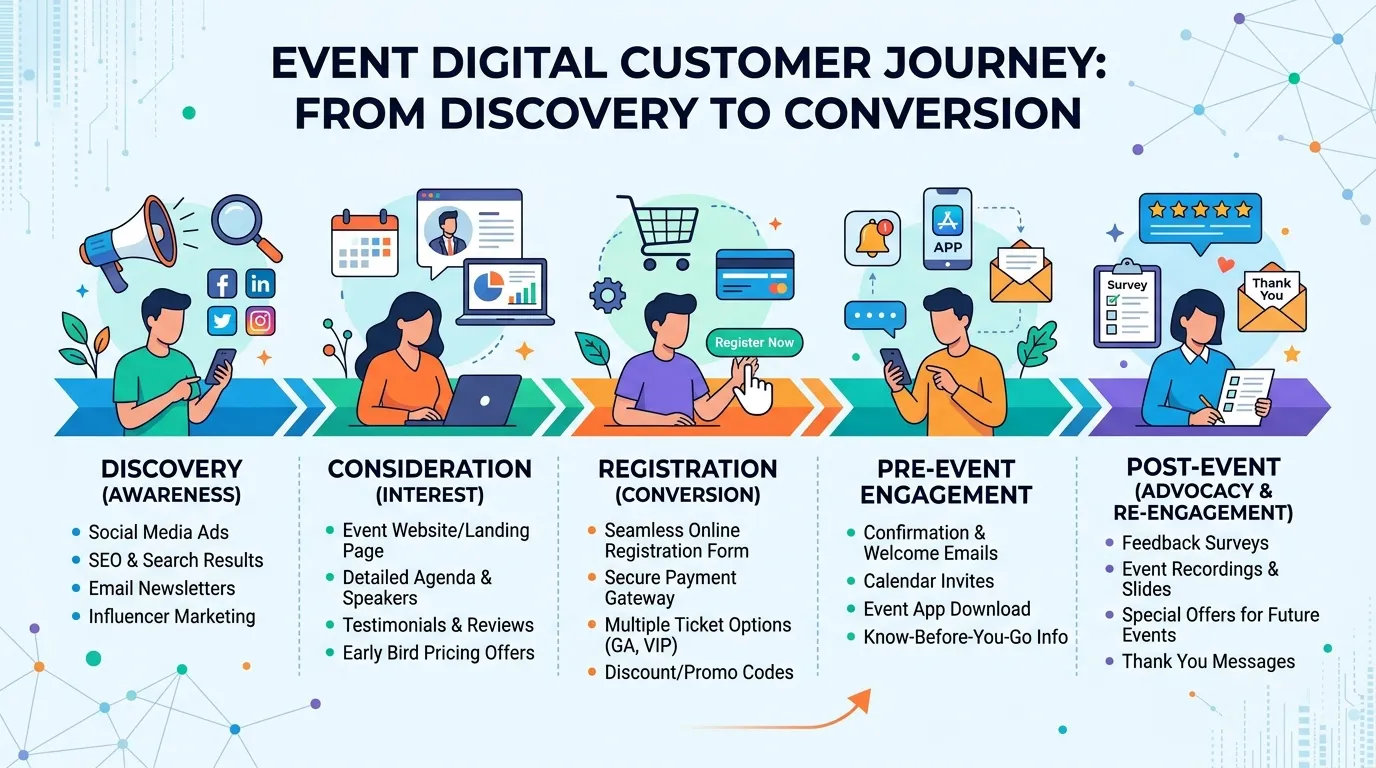
An Event Digital Customer Journey describes the digital path an attendee takes while discovering, researching, registering for, attending, and engaging with an event. From search engines and social media to registration pages, emails, event platforms, and post-event communications, every interaction can influence the attendee experience. A well-connected digital journey helps event organizers create relevant experiences, strengthen engagement, increase registrations, and build lasting relationships with attendees.
What Is an Event Digital Customer Journey?
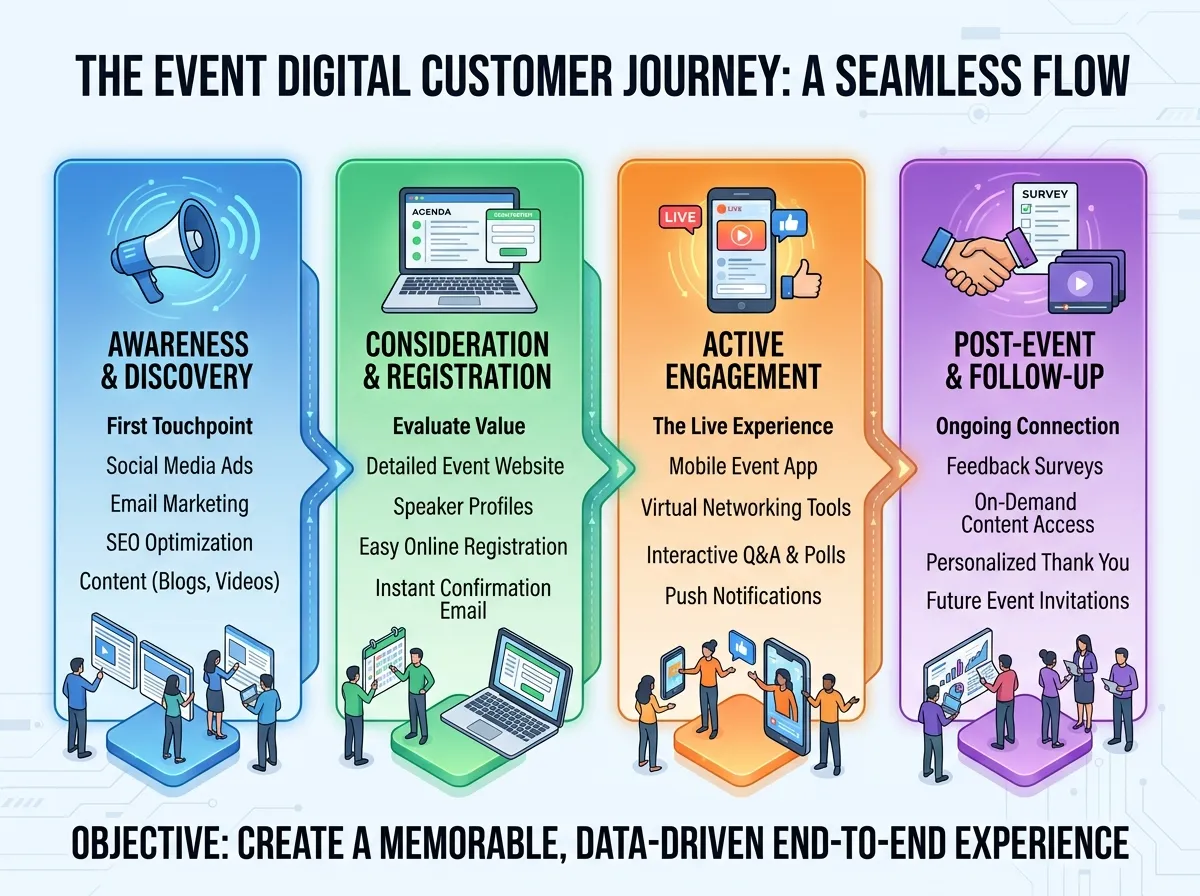
An Event Digital Customer Journey represents the series of online interactions that an attendee may have with an event before, during, and after it takes place. Unlike a traditional event experience that may focus primarily on the physical venue, the digital journey can begin weeks or months before the event and continue long after the final session.
An attendee may first discover an event through a search engine, social media post, advertisement, email, referral, or industry website. After discovering the event, the person may visit the event website, explore speakers and sessions, compare ticket options, read event information, and eventually register.
The journey continues after registration. Attendees may receive confirmation emails, reminders, agenda updates, speaker information, mobile notifications, and personalized recommendations. During the event, digital platforms can support networking, session participation, questions, polls, and content access.
After the event, follow-up emails, recordings, surveys, community engagement, and future event promotions can continue the relationship. This makes the digital customer journey a connected experience rather than a single registration interaction.
Why the Event Digital Customer Journey Matters
Events compete for attention across many digital channels. Potential attendees may encounter numerous conferences, webinars, exhibitions, workshops, and virtual experiences before deciding which ones deserve their time and money.
A strong digital journey can make an event easier to discover and understand. When information is consistent across websites, social platforms, emails, registration pages, and event applications, attendees can move between touchpoints with less confusion.
The journey also influences trust. Clear event information, convenient registration, timely communication, and relevant content can create confidence before the attendee even arrives.
For organizers, understanding the digital journey can also reveal where potential attendees lose interest. If people visit an event page but rarely complete registration, there may be an issue with the information, messaging, registration experience, or perceived value.
The goal is therefore not simply to increase the number of digital interactions. It is to make those interactions useful and connected.
Event Customer Journey Mapping
Event Customer Journey Mapping provides a visual and strategic way to understand how people interact with an event throughout the customer lifecycle. It considers what attendees do, what information they need, what questions they may have, and how they feel at different points.
Early in the journey, potential attendees may need basic information about the event’s purpose, audience, speakers, topics, location, dates, or benefits. As interest develops, they may want more specific information about sessions, networking opportunities, pricing, accommodation, technology requirements, or event accessibility.
After registration, their needs change again. They may want reminders, schedules, speaker updates, instructions, and personalized recommendations.
Mapping these experiences allows event teams to understand the relationship between attendee needs and digital communications. It can also reveal unnecessary friction or gaps where attendees are not receiving enough information.
A journey map can therefore support better coordination across marketing, registration, event operations, technology, and post-event engagement.
Digital Event Customer Experience
The Digital Event Customer Experience includes every digital interaction an attendee has with an event brand. This can include the event website, registration system, emails, mobile application, virtual event platform, social media channels, customer support, surveys, and digital content.
Each interaction contributes to the overall perception of the event. A visually attractive website may create interest, but if registration is confusing, the experience can quickly become frustrating. Similarly, a smooth registration process may be weakened by unclear event communications afterward.
Consistency is especially important. Event information should remain accurate across the different channels attendees use. Changes to session times, speakers, locations, or access instructions should be communicated clearly and promptly.
The digital experience should also account for different attendee needs. Some people may primarily use mobile devices, while others may interact through desktop computers. Some attendees may want quick answers, while others may prefer detailed information.
A flexible experience can make the journey more accessible and useful for different audience segments.
Event Marketing Customer Journey
The Event Marketing Customer Journey connects marketing activity with the stages an attendee experiences before and after an event. Marketing does not stop when someone registers. Instead, registration can mark the transition into another stage of communication.
Before registration, marketing content may focus on awareness and interest. Event announcements, educational content, speaker introductions, social media campaigns, and promotional materials can help potential attendees understand the event’s value.
Once someone registers, communications can shift toward preparation and anticipation. Personalized emails, agenda information, networking opportunities, and useful event resources can help attendees feel prepared.
After the event, marketing can focus on continued engagement. Organizers may share recordings, summaries, surveys, additional resources, community opportunities, or information about future events.
This creates a continuous relationship between marketing and attendee experience rather than treating promotion as a separate activity from event delivery.
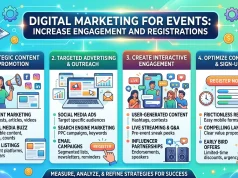
Businesses looking to strengthen their event promotion efforts can explore Digital Marketing for Events, which provides additional context on using digital marketing to support event engagement and registrations.
Event Attendee Journey Mapping
Event Attendee Journey Mapping focuses specifically on the experience of people who interact with an event before, during, and after participation.
Different attendees may follow different paths. One person may discover an event through organic search, while another may arrive through a referral from a colleague. A third attendee may encounter an event through social media or a previous event relationship.
Their expectations can also vary. First-time attendees may require more information about what to expect, while returning attendees may be more interested in advanced sessions or networking opportunities.
Mapping these differences can help organizers create more relevant communications without making the experience unnecessarily complicated.
Attendee journey mapping can also connect digital interactions with physical event experiences. For example, a registration email can prepare attendees for check-in, while an event application can help them navigate sessions and networking opportunities once they arrive.
Digital Customer Experience Strategy for Events
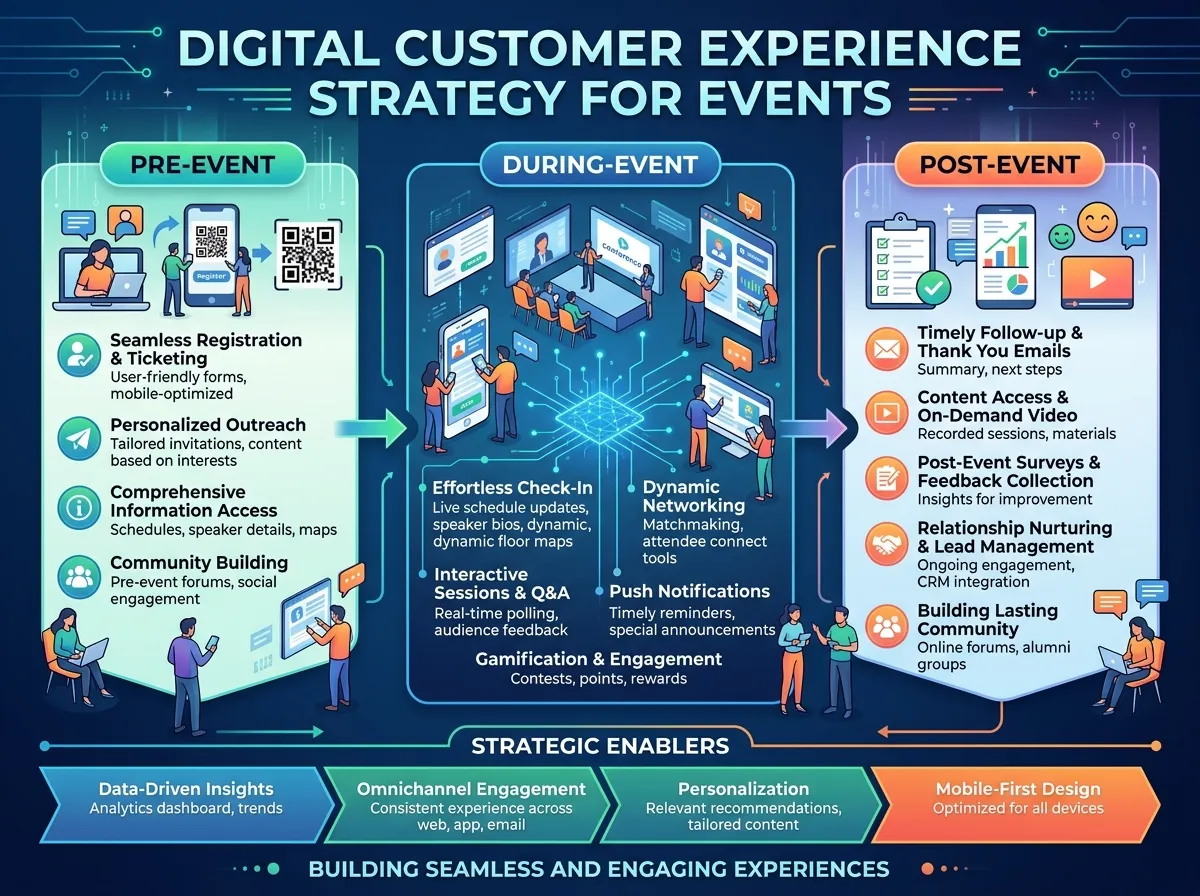
A Digital Customer Experience Strategy helps event organizers create consistency across the various digital touchpoints that shape attendee interactions.
The strategy should consider the complete experience rather than focusing on individual platforms. A website, email campaign, registration platform, mobile application, and social media account should work together rather than communicating unrelated messages.
Data can support this strategy by helping organizers understand attendee behavior. Website analytics may reveal which event pages attract attention, registration data can show conversion patterns, and engagement data can indicate which sessions or communications generate the most interest.
Personalization can also play a role. Attendees may receive different recommendations based on their interests, registration information, previous event participation, or selected sessions.
The objective is to make the journey feel relevant without creating unnecessary complexity.
Event Engagement Journey
The Event Engagement Journey describes how an attendee’s involvement develops throughout the event lifecycle. Engagement can begin before registration and continue through post-event interactions.
Pre-event engagement might include social discussions, speaker content, email communication, community conversations, and educational resources. These interactions can create familiarity and anticipation.
During the event, engagement can involve session participation, live questions, polls, networking, discussions, content downloads, and social sharing.
Post-event engagement can include surveys, recordings, community participation, follow-up resources, and future event invitations.
Strong engagement is not necessarily about maximizing the number of interactions. Quality and relevance are equally important. An attendee who finds one highly relevant session and meaningful networking opportunity may have a stronger experience than someone who interacts with dozens of irrelevant features.
Event Conversion Journey
The Event Conversion Journey focuses on how potential attendees move from initial awareness toward a desired action, such as registration, ticket purchase, attendance confirmation, session participation, or another measurable event objective.
Conversion can be influenced by many factors. Clear messaging, compelling event value, social proof, simple registration processes, transparent pricing, and timely communication can all affect the decision.
Not every visitor will convert immediately. Someone may discover the event through a social post, leave the website, return after receiving an email, and register several days later.
This means event teams should consider the full journey rather than attributing every conversion to the final interaction.
Conversion data can also help organizers identify where potential attendees leave the journey. If many people visit registration pages but fail to complete registration, that stage deserves closer attention.
Event Audience Journey Strategy
An Event Audience Journey Strategy brings together audience understanding, content, communication, engagement, and conversion into a connected experience.
Different audience segments may have different motivations for attending. Some may be interested in education, others in networking, business opportunities, professional development, product discovery, or entertainment.
Understanding these motivations helps organizers communicate event value more effectively.
Audience segmentation can also influence content recommendations. Someone interested in marketing sessions may receive recommendations focused on marketing topics, while another attendee may be more interested in technology or networking.
A strong audience journey strategy therefore connects event data with relevant experiences while maintaining a consistent event identity.
Event Touchpoint Mapping
Event Touchpoint Mapping identifies the various moments when attendees interact with an event brand. These touchpoints can include search results, advertisements, social posts, event websites, registration forms, confirmation emails, reminders, mobile apps, event platforms, support channels, and follow-up communications.
Each touchpoint represents an opportunity to provide useful information or create friction.
For example, an advertisement may create initial awareness, but the landing page needs to reinforce the same message. A registration confirmation should provide clear next steps, while reminder emails should contain information that attendees actually need at that stage.
Touchpoint mapping can reveal inconsistencies that may otherwise remain unnoticed. When organizers examine the entire journey, they can better understand how individual interactions influence the overall experience.
Event Customer Experience Optimization
Event Customer Experience Optimization focuses on improving the quality, relevance, and efficiency of attendee interactions across the journey.
Optimization can involve improving website navigation, simplifying registration, strengthening email communication, personalizing recommendations, improving mobile experiences, enhancing event platforms, or making post-event follow-up more relevant.
Analytics and attendee feedback can provide valuable evidence. Website behavior can reveal where visitors struggle, while surveys can show what attendees liked or disliked about their experience.
Optimization should also be continuous. Audience expectations change, technology evolves, and each event can provide new information about what attendees value.
The most effective improvements are therefore connected to real attendee behavior rather than assumptions about what users want.
Connecting Digital and Virtual Event Experiences
The digital customer journey becomes especially important when events are fully or partially virtual. In these environments, the digital experience may represent almost the entire attendee journey.
Virtual event marketing can include promotional campaigns, registration experiences, pre-event communications, online networking, live sessions, digital content, and post-event engagement.
Organizers can explore Virtual Event Marketing Strategies to understand how digital marketing approaches can support online event engagement.
The principles of journey mapping remain relevant whether an event is physical, virtual, or hybrid. Attendees still need clear information, relevant communication, convenient access, and meaningful opportunities to participate.
Event Referral Marketing and the Customer Journey
Attendees can also become an important part of the event’s digital journey. A satisfied attendee may recommend the event to colleagues, share content on social media, or invite others to participate.
This makes referral activity an extension of the customer journey. An attendee who has a positive experience can become a source of awareness for potential future attendees.
Event Referral Marketing can connect attendee satisfaction with audience growth by encouraging participants to share their experiences and invite relevant people.
The approach works particularly well when the event provides genuine value and gives attendees a natural reason to talk about it. More information about this relationship can be found in Event Referral Marketing.
Event Management and the Digital Journey
The digital customer journey cannot be separated completely from event operations. Information communicated online needs to match the actual event experience.
For example, if an event website promises a particular session format, networking experience, or registration process, the operational team needs to deliver what attendees were promised.
This makes coordination between marketing and event management important. Changes to schedules, venues, speakers, technology, or attendee services can affect multiple digital touchpoints.
Strong Event Management Planning can help connect operational decisions with attendee communication. Event Management Planning provides additional context on how planning supports successful event delivery.
When marketing, technology, and operations work together, attendees are more likely to experience a consistent journey from initial discovery through post-event communication.
Creating a Connected Event Experience
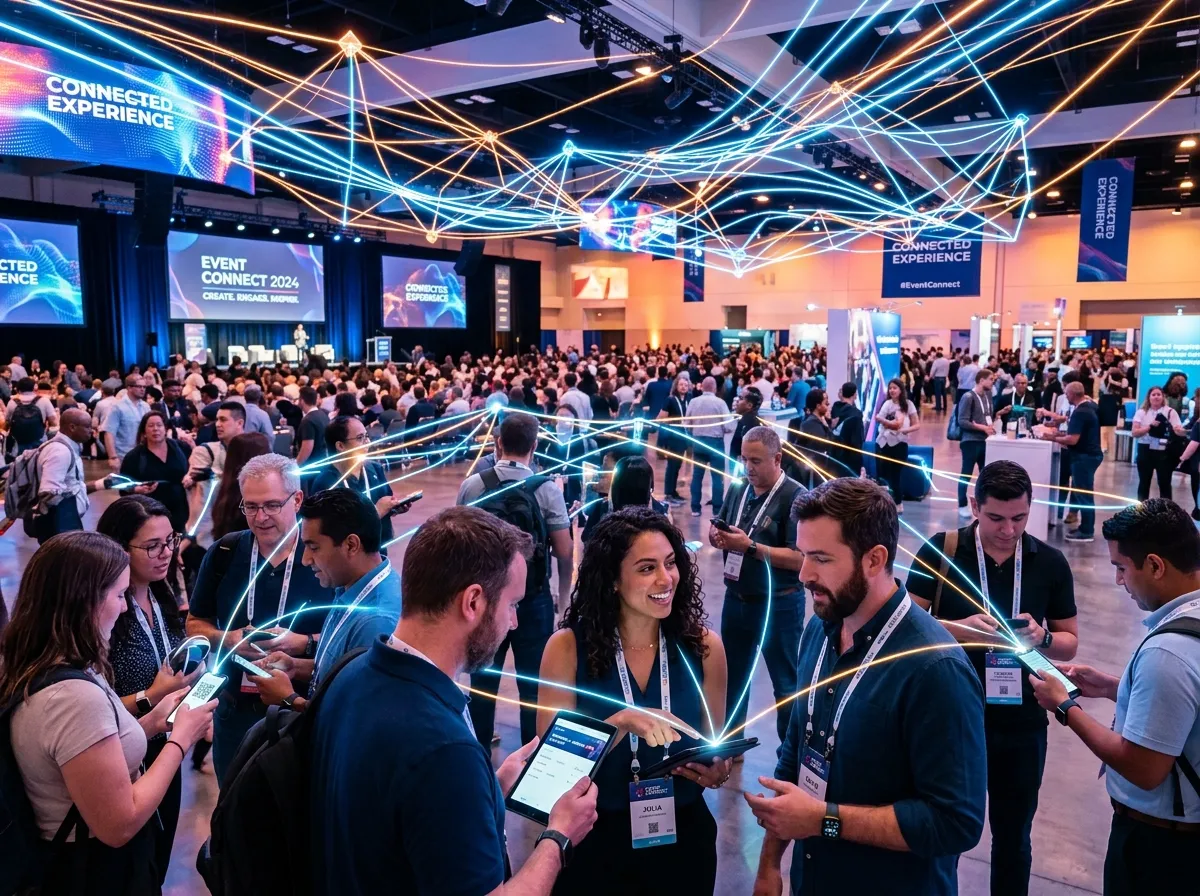
The modern event experience extends beyond the event itself. Attendees can interact with an event brand through numerous digital channels before they ever arrive and continue those interactions long after the event ends.
An effective Event Digital Customer Journey connects these experiences into a coherent relationship. Awareness leads to consideration, consideration can lead to registration, registration leads to participation, and participation can develop into continued engagement.
The journey should remain flexible because attendees do not all behave in the same way. Some will move quickly from discovery to registration, while others may need multiple interactions before making a decision.
By understanding these different paths, event organizers can create more relevant content, stronger communications, and better experiences.
Conclusion
An Event Digital Customer Journey provides a broader view of how attendees discover, evaluate, register for, participate in, and continue interacting with an event. It connects marketing, technology, communication, event operations, and customer experience into one continuous journey.
From Event Customer Journey Mapping and Event Attendee Journey Mapping to Event Touchpoint Mapping, Event Engagement Journey, and Event Customer Experience Optimization, each element can help organizers understand how digital interactions influence attendee behavior.
A successful event experience is not created through one website, one email, or one registration page. It is shaped by the complete collection of interactions that attendees experience over time. When those touchpoints are connected and relevant, event organizers can create stronger relationships, improve engagement, support conversions, and build experiences that encourage attendees to return.
Frequently Asked Questions
1. What is an Event Digital Customer Journey?
An Event Digital Customer Journey is the sequence of digital interactions an attendee has with an event before, during, and after participation. It can include websites, social media, emails, registration systems, event applications, virtual platforms, and post-event communications.
2. Why is an Event Digital Customer Journey important?
It helps organizers understand how attendees discover and interact with an event. Mapping the journey can reveal opportunities to improve communication, engagement, registration, conversion, and the overall attendee experience.
3. What is Event Customer Journey Mapping?
Event Customer Journey Mapping is the process of visualizing and analyzing attendee interactions throughout the event lifecycle. It considers audience needs, touchpoints, communication, behavior, and potential friction.
4. How does digital customer experience affect events?
Digital customer experience influences how attendees perceive an event before, during, and after participation. Website usability, registration, communication, event technology, and follow-up can all affect the overall experience.
5. What is Event Touchpoint Mapping?
Event Touchpoint Mapping identifies the different points where attendees interact with an event brand. These can include advertisements, websites, emails, registration pages, mobile apps, social media, event platforms, and post-event communications.
6. How does journey mapping improve event engagement?
Journey mapping helps organizers understand what attendees need at different stages. This can make communication more relevant and create better opportunities for participation before, during, and after an event.
7. What is an Event Conversion Journey?
An Event Conversion Journey describes the path a person takes from initial awareness toward a desired action, such as registering, purchasing a ticket, confirming attendance, or participating in an event activity.
8. How can event organizers optimize the customer experience?
Organizers can use attendee feedback, analytics, registration data, engagement information, and other evidence to identify areas where the experience can be improved. Optimization can involve digital channels, communication, registration, event technology, and follow-up.
9. Can Event Digital Customer Journey strategies work for virtual events?
Yes. Virtual events rely heavily on digital interactions, making journey planning particularly important. Websites, registration systems, email communication, virtual platforms, networking tools, and post-event resources can all contribute to the attendee journey.
10. How does referral marketing fit into the event customer journey?
Referral marketing can extend the customer journey by encouraging satisfied attendees to share the event with colleagues, friends, or professional networks. This can create additional awareness and introduce new potential attendees to the event.