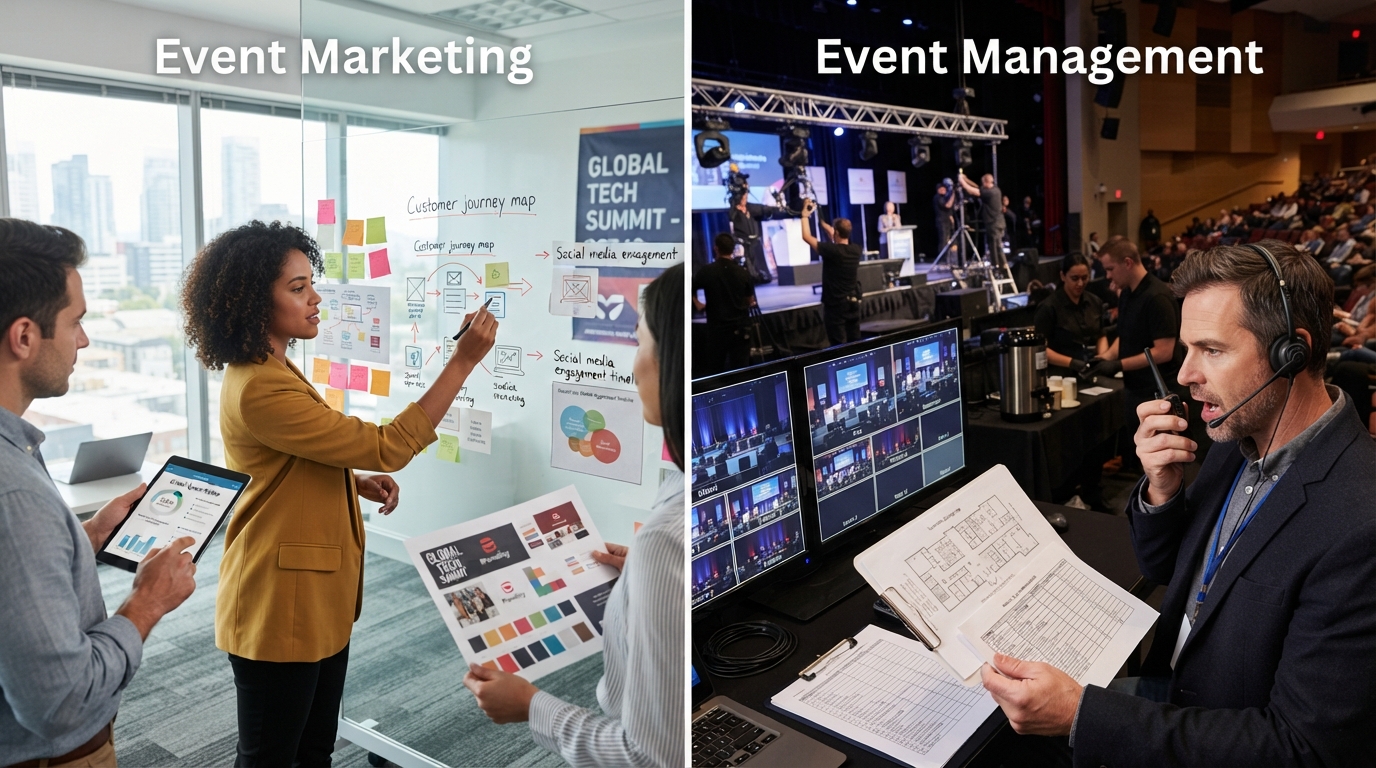
Event marketing focuses on promoting a brand or product through events, while event management covers the operational planning and execution of those events. Both are distinct disciplines that often work together to deliver successful outcomes.
Most people use the terms interchangeably. That’s understandable—they sound similar, they often involve the same events, and professionals in both fields frequently collaborate. But conflating the two can lead to real confusion, especially when hiring, budgeting, or building a career strategy.
This blog post breaks down exactly what sets each discipline apart. You’ll learn how the goals, responsibilities, skill sets, and career paths differ, and why understanding the distinction matters whether you’re a business owner, marketer, or aspiring event professional.
By the end, you’ll have a clear, practical understanding of where event marketing and event management overlap, where they diverge, and how they complement each other to create events that actually achieve something.
Defining the Two Disciplines
Before diving into comparisons, it helps to define each field on its own terms. Event marketing and event management are related but serve fundamentally different purposes within the broader events industry.
What Is Event Marketing?
Event marketing is a strategy that uses live or virtual experiences—conferences, product launches, trade shows, pop-ups, webinars—to promote a brand, product, or service. The primary goal is to generate awareness, build relationships, and drive measurable business outcomes like leads, sales, or customer loyalty.
Event marketing and event management both exist within the events ecosystem, but event marketing is fundamentally audience-facing. It asks: Who are we trying to reach? What message do we want them to walk away with? How does this event support our broader marketing funnel?
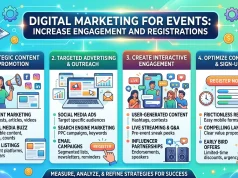
Event marketers work closely with content, digital, and brand teams. They craft the event narrative, design promotional campaigns, manage registration funnels, and measure ROI through metrics like attendance rates, social impressions, and post-event conversions.
What Is Event Management?
Event management is the discipline responsible for planning, coordinating, and executing an event from start to finish. It encompasses venue sourcing, vendor negotiation, logistics, staffing, scheduling, budget management, and on-site operations.
Where event marketing asks why an event is happening and who it serves, event management asks how it gets done. Event managers are the operational backbone of any successful event. Without their work, even the most compelling event marketing strategy falls flat on execution day.
Event management professionals are detail-oriented, process-driven, and skilled at managing multiple moving parts under pressure. Their success is measured differently—not by brand lift or lead generation, but by whether the event ran smoothly, on time, and within budget.
Event Marketing vs Event Management Explained
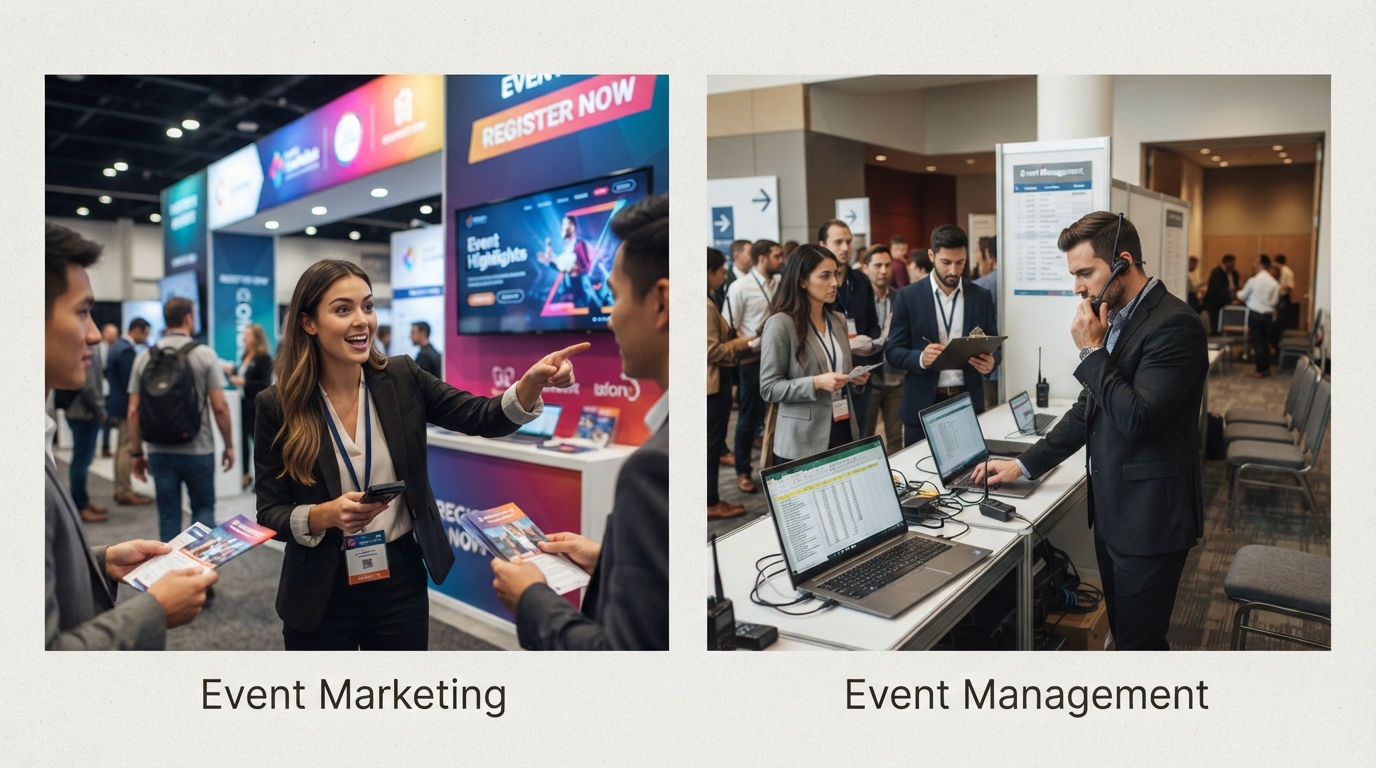
The clearest way to understand the difference is to look at where each function starts and ends.
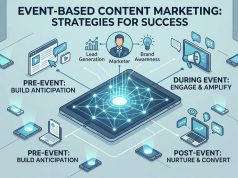
Event marketing typically begins months before an event. Marketers identify the target audience, set campaign objectives, develop the promotional strategy, and create content to drive registrations. Their work peaks before and during the event, and continues afterward through follow-up campaigns, lead nurturing, and performance analysis.
Event management, by contrast, is heavily weighted toward pre-event logistics and day-of execution. Event managers coordinate the venue, manage supplier contracts, build run-of-show documents, and ensure every operational element—from AV equipment to catering—is in place when it needs to be.
Here’s a structured comparison to make event marketing vs event management explained more concrete:
|
Dimension |
Event Marketing |
Event Management |
|---|---|---|
|
Primary Goal |
Brand awareness, lead generation, audience engagement |
Flawless event execution, logistics coordination |
|
Key Activities |
Campaigns, promotions, registrations, ROI tracking |
Venue sourcing, vendor management, scheduling |
|
Main Stakeholders |
Marketing team, sales, brand managers |
Operations team, suppliers, venue staff |
|
Success Metrics |
Attendance, leads, conversions, social reach |
Budget adherence, timeline, attendee satisfaction |
|
Timeline Focus |
Pre-event and post-event |
Pre-event and day-of execution |
|
Core Skills |
Strategy, copywriting, analytics, digital marketing |
Project management, negotiation, logistics, problem-solving |
Both functions are essential. One without the other produces either a beautifully marketed event no one attends, or a logistically perfect event that fails to move the needle for the business.
How Event Marketing Differs from Event Management in Terms of Goals
Understanding how event marketing differs from event management becomes clearest when you look at what each discipline is ultimately trying to achieve.
Event marketing is outcome-driven in a commercial sense. Every decision—the event format, the speaker lineup, the promotional channels—is evaluated through the lens of business impact. A B2B SaaS company hosting a user conference, for example, might measure success by how many attendees book a demo, upgrade their plan, or become brand advocates.
Event management, on the other hand, is operationally driven. Its goal is to create the conditions under which the marketing objectives can be met. An event manager doesn’t own the lead generation target, but their work directly enables or undermines it. A registration check-in process that takes 45 minutes will sour the attendee experience regardless of how compelling the content was.
This distinction in goals shapes everything—how success is defined, how budgets are allocated, and how performance is reported back to leadership.
Strategic vs. Operational Thinking
Event marketing and event management require different thinking modes. Event marketing calls for strategic, big-picture thinking: understanding market positioning, buyer psychology, and brand storytelling. Event management calls for systematic, detail-oriented thinking: anticipating risks, building contingency plans, and keeping complex timelines on track.
Neither is superior. They are complementary. The best events happen when strategic marketing intent is matched by equally strong operational execution.
Event Marketing and Event Management Roles: Who Does What?
Knowing the roles within each discipline helps clarify the practical differences.
Typical Event Marketing Roles
- Event Marketing Manager — Develops the overall event marketing strategy, owns the promotional calendar, and manages campaign execution across channels including email, paid media, and social.
- Content Strategist — Creates pre-event content such as speaker spotlights, blog posts, and session previews to drive registrations and build anticipation.
- Demand Generation Specialist — Focuses on filling the registration funnel through targeted outreach, paid advertising, and partnerships.
- Marketing Analyst — Tracks performance data before, during, and after the event to measure ROI and inform future strategy.
Typical Event Management Roles
- Event Manager / Event Planner — The central coordinator responsible for every logistical element, from the initial site inspection to the final vendor debrief.
- Operations Coordinator — Supports the event manager on specific workstreams such as catering, AV, or attendee registration.
- Production Manager — Oversees the technical and creative production elements, including stage design, lighting, and sound.
- On-Site Event Staff — Manages day-of logistics, directs attendees, and troubleshoots issues as they arise.
In large organizations, event marketing and event management roles are held by separate teams. In smaller companies or agencies, one person may wear both hats—a reality that often blurs the conceptual distinction between the two disciplines.
Event Marketing vs Event Management Examples
Abstract definitions become much clearer with real-world illustrations. Here are concrete event marketing vs event management examples across different event types.
Example 1: Product Launch
An electronics brand is launching a new wireless headphone.
The event marketing team develops a campaign targeting tech enthusiasts and music lovers. They run targeted Instagram and YouTube ads, partner with influencers for pre-launch content, build a landing page with a countdown timer, and create an email sequence to registered attendees.
The event management team, meanwhile, sources a venue in a central city location, negotiates contracts with a catering company and AV supplier, designs the floor plan, prepares a detailed run-of-show document, and coordinates a rehearsal the day before.
Both teams are working toward the same event, but their responsibilities and success metrics are entirely different.
Example 2: Annual Industry Conference
For a professional association hosting its annual conference, the event marketing team handles sponsorship packages, speaker promotion, registration campaigns, and post-event content amplification. Their KPIs include registration numbers, sponsor ROI, and social media reach.
The event management team handles hotel room blocks, shuttle logistics, session scheduling, name badge printing, and managing a team of 30 volunteers on the day. Their KPIs include attendee satisfaction scores and whether the event ran to schedule.
Example 3: Virtual Webinar
Even in a digital environment, the distinction holds. Event marketing owns the registration page, the email nurture sequence, the LinkedIn promotion, and the post-webinar follow-up campaign. Event management handles the technical setup, hosts the platform, manages the speaker briefing, coordinates the live Q&A, and ensures the recording is captured cleanly for repurposing.
Event Marketing vs Event Planning — Is There a Difference?
This is a question that causes additional confusion. Event marketing vs event planning is often treated as interchangeable, but there’s a subtle distinction worth noting.
Event planning is a subset of event management. It refers specifically to the pre-event phase: selecting dates, identifying venues, building budgets, and creating timelines. Event management is the broader term that encompasses planning and execution.
Event marketing, by contrast, remains entirely within the promotional and strategic domain. An event planner might never write a single line of ad copy. An event marketer might never check whether the AV equipment is compatible with the venue’s electrical system.
Understanding where event planning sits within the event management umbrella helps clarify why event marketing vs event planning comparisons are slightly misleading—event planning is one part of event management, while event marketing is an entirely different function.
Is Event Marketing the Same as Event Management?
The short answer is no. Is event marketing the same as event management? The two terms describe different professional disciplines with different objectives, skill requirements, and success metrics.
They do share common ground. Both involve events. Both require cross-functional collaboration. Both professionals attend the same planning meetings and care deeply about the attendee experience. But the motivations and accountabilities that drive their work are distinct.
Thinking of them as the same can cause real problems in practice. It can lead to unclear ownership, budget disputes, and gaps in both strategy and execution. A company that hires a single person to “run events” without clarifying whether they need an event marketer or an event manager often ends up disappointed—not because the person failed, but because the role was never properly defined.
Event Marketing and Event Management Comparison: How They Work Together
While this post has focused on their differences, it’s equally important to understand how event marketing and event management work in tandem. The comparison is not meant to create competition between them—they are most powerful when aligned.
The Handoff Points
The collaboration between event marketing and event management teams typically follows a sequence:
- Strategy phase — Event marketing defines the audience, objectives, and positioning. Event management provides feasibility input on venues, formats, and timelines.
- Promotion phase — Event marketing drives registrations. Event management builds the operational infrastructure to handle attendee volumes.
- Execution phase — Event management runs the show. Event marketing activates on-site engagement tactics like social walls, photo opportunities, and real-time content capture.
- Post-event phase — Event marketing uses attendee data and content captured during the event for follow-up campaigns. Event management conducts vendor debriefs and documents learnings for future events.
When these handoffs are clearly defined and both teams communicate proactively, the result is an event that looks seamless from the outside and delivers measurable value on the inside.
Where Friction Typically Occurs
Common friction points include budget ownership (does the event marketing budget cover the venue?), timeline alignment (marketing needs more lead time for promotion than operations needs for logistics), and post-event data access (event managers often hold registration data that marketers need for follow-up).
Organizations that establish shared processes and clear accountability structures between these two functions consistently produce better events and better results.
Event Marketing vs Event Management Career Differences
For professionals considering which path to pursue, the event marketing vs event management career differences are significant.
Event Marketing Career Path
An event marketing career typically develops through broader marketing functions. Many event marketers start in digital marketing, content, or demand generation before specializing in events. The skills that matter most include campaign strategy, copywriting, data analysis, and understanding of marketing technology stacks including CRM platforms, email automation tools, and analytics dashboards.
Career progression often moves from Event Marketing Coordinator to Event Marketing Manager, and then to Director of Event Marketing or Head of Experiential. In larger organizations, this can extend to VP of Field Marketing or Chief Marketing Officer.
Event Management Career Path
Event management careers often begin in hospitality, venue coordination, or event assistant roles. The skills that matter most are project management, vendor negotiation, budgeting, risk assessment, and on-site problem-solving. Professional certifications like the Certified Meeting Professional (CMP) or the Certified Special Events Professional (CSEP) can accelerate career growth.
Progression typically moves from Event Coordinator to Event Manager, then to Senior Event Manager or Head of Events, and potentially to Director of Operations or Vice President of Events at the organizational level.
Salary and Industry Demand
Both fields offer strong career prospects. Event marketing roles in B2B technology companies tend to command higher salaries due to the direct link between event performance and pipeline generation. Event management professionals with specialist expertise in large-scale conferences, corporate events, or international productions can also command premium rates, particularly through independent consulting or agency work.
|
Career Dimension |
Event Marketing |
Event Management |
|---|---|---|
|
Background |
Marketing, communications, digital |
Hospitality, operations, project management |
|
Core Skills |
Strategy, analytics, storytelling |
Logistics, negotiation, coordination |
|
Certifications |
Google Analytics, HubSpot, Meta Blueprint |
CMP, CSEP, PRINCE2 |
|
Career Goal Alignment |
Brand growth, lead generation |
Operational excellence, client satisfaction |
|
Typical Employers |
B2B tech companies, agencies, media brands |
Event agencies, hotels, corporate in-house teams |
Which Discipline Should You Focus On?
The right path depends entirely on where your strengths and interests lie.
Choose event marketing if you enjoy building campaigns, understanding audience psychology, working with data, and connecting events to commercial outcomes. You’ll thrive in fast-paced marketing environments where events are one channel within a broader go-to-market strategy.
Choose event management if you’re energized by logistics, thrive under operational pressure, enjoy building relationships with vendors and venues, and find satisfaction in the flawless delivery of complex experiences. You’ll excel in roles where execution quality is the primary measure of success.
Some professionals genuinely enjoy both. If that’s you, look for roles at smaller companies or boutique agencies where wearing multiple hats is the norm rather than the exception. Over time, you can choose to specialize based on where your impact is greatest.
The Distinction That Makes a Real Difference

Event marketing and event management are two sides of the same coin. One creates the reason to attend; the other creates the conditions that make attendance worthwhile. Organizations that treat these disciplines as interchangeable tend to underinvest in one at the expense of the other—and their events reflect it.
Whether you’re building a career, structuring a team, or planning your next event, understanding this distinction is the foundation for making better decisions. Event marketing drives the strategy. Event management delivers the experience. Together, they determine whether an event simply happens—or genuinely achieves something.
Frequently Asked Questions
1. What is the main difference between event marketing and event management?
Event marketing focuses on promoting events to achieve brand or business goals, while event management covers the logistical planning and operational execution of those events. Marketing is strategic and audience-focused; management is operational and process-focused.
2. Can one person handle both event marketing and event management?
Yes, especially in small businesses or startups. However, as events grow in scale and complexity, it’s advisable to separate the two functions to ensure adequate focus on both strategy and operations.
3. Which is more important: event marketing or event management?
Neither is more important—they are interdependent. Strong event marketing without solid event management leads to a poorly executed experience. Strong event management without marketing leads to low attendance and poor ROI.
4. Is event planning the same as event management?
Not exactly. Event planning refers to the pre-event preparation phase, while event management encompasses planning, execution, and post-event evaluation. Event planning is one component of event management.
5. What qualifications do I need for a career in event marketing?
A background in marketing, communications, or business is typical. Certifications in digital marketing tools like Google Analytics, HubSpot, or Meta advertising platforms are highly valued by employers.
6. What qualifications do I need for a career in event management?
A background in hospitality, project management, or business operations is common. Professional certifications like the Certified Meeting Professional (CMP) or Certified Special Events Professional (CSEP) can significantly strengthen your credentials.
7. How do event marketing and event management teams collaborate?
They typically collaborate across four phases: strategy, promotion, execution, and post-event analysis. Clear handoff points, shared timelines, and joint planning meetings help ensure both functions work toward the same outcomes.
8. What metrics does event marketing use to measure success?
Common event marketing metrics include registration numbers, attendance rates, cost per lead, pipeline generated, social media impressions, and post-event conversion rates.
9. What metrics does event management use to measure success?
Event management success is typically measured by budget adherence, timeline accuracy, attendee satisfaction scores, vendor performance, and the absence of operational issues during the event.
10. Is event marketing a good career choice in 2024?
Yes. Demand for event marketing professionals, particularly those with digital and data skills, continues to grow as organizations invest more in live and virtual experiences as part of their go-to-market strategies.